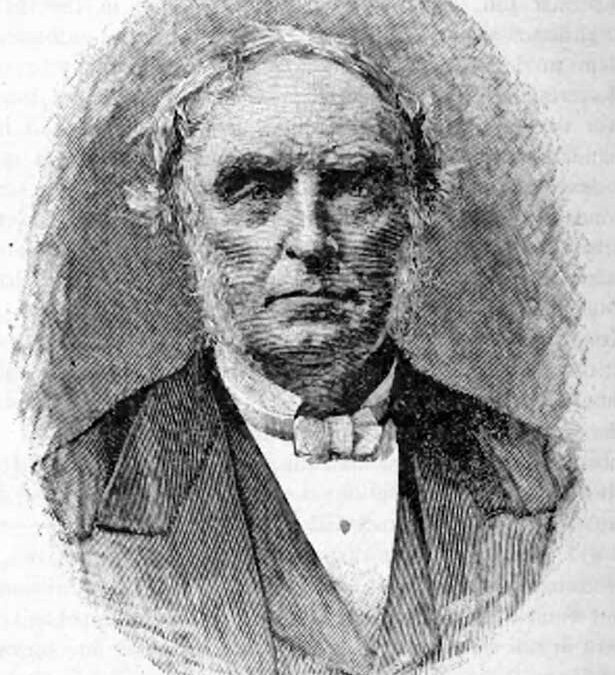
The original translation of Tao Te Ching was completed by James Legge and published in 1891 as part of the Sacred Books of the East, one of the most ambitious scholarly projects of the nineteenth century. To read this text today is to benefit from a lifetime of work by a man who arguably understood Chinese thought more deeply than any Western scholar of his era — and who was willing to pay a real professional price for that understanding.
The Man Behind the Translation
James Legge was born in 1815 in Huntly, Aberdeenshire, Scotland. He trained as a missionary and arrived in Asia in 1839, initially stationed in Malacca before moving to Hong Kong, where he would spend thirty years. He was not a scholar who read about China from a distance. He lived there, learned the language to a standard that allowed him to work directly with classical texts and native commentators, and came to the conclusion early on that a missionary who did not understand the intellectual and spiritual traditions of the people he was working with was operating blindly.
This conviction drove him to begin translating the Chinese classics in 1841 — a project he described as a necessity, not an ambition. His method was rigorous: before settling on any interpretation, he consulted hundreds of Chinese commentators across different dynasties, attempting to understand not just what a text said but what it had meant to Chinese readers across two thousand years. His colleague Joseph Edkins observed that the result was something unusual for Western scholarship: a translation that reflected how the Chinese themselves had understood their own classics.
In 1876, Legge was appointed as the first Professor of Chinese Language and Literature at Oxford University — the first nonconformist to hold a professorship there. He was sixty years old. He rose at three o'clock every morning, made himself tea over a spirit lamp, and worked at his translations while the rest of the household slept. He continued this routine for twenty years until his death in 1897.
Despite his output — or perhaps because of its depth — Legge was a controversial figure throughout his career. Fellow missionaries accused him of giving too much respect to Confucianism. When he included Chinese texts in Max Müller's *Sacred Books of the East* series alongside Hindu, Buddhist, and Zoroastrian scripture, critics charged him with placing non-Christian writings on the same level as the Bible. The controversy even acquired a name: "Leggism." He remained largely untroubled by it. He had come to believe that the ancient Chinese possessed genuine moral and spiritual insight, and he was not prepared to pretend otherwise for the sake of orthodoxy.
In 1875, he received the first Julien Prize for sinology, the most prestigious award in his field. In 1894, he became the first person outside the British royal family to appear on a Hong Kong postage stamp. Chad Hansen, one of the leading scholars of Chinese philosophy, later called him "the incomparable father of all sinologists."
The Sacred Books of the East
The Sacred Books of the East was the idea of Friedrich Max Müller, a German-born philologist and professor of comparative philology at Oxford. Müller had spent decades arguing that the study of religion required the same rigorous textual methods that had already transformed classical and biblical scholarship. In 1875, he persuaded Oxford University Press to commit to something no Western publisher had attempted: a systematic translation of the principal religious texts of Asia and the Middle East, produced to the highest academic standards and made available in a single series.
The project ran to fifty volumes, published between 1879 and 1891. It brought together the leading Orientalist scholars of the day, each working in their own area of expertise. The texts covered included the Hindu Vedas and Upanishads, the Buddhist Dhammapada, the Zoroastrian Avesta, the Islamic Quran, the Confucian Analects, and many others. Legge contributed six volumes, covering Confucian texts, Tao Te Ching, the writings of Chuang-tzŭ, and several shorter Taoist works.
The timing was not accidental. The 1870s and 1880s were the peak years of European imperial expansion, and with that expansion came a growing awareness — sometimes uncomfortable — that the civilizations being encountered were not the blank slates that colonial ideology preferred to imagine. The Sacred Books of the East reflected a strand of Victorian intellectual culture that took seriously the possibility that non-Western traditions contained genuine wisdom. Müller's comparative method was built on exactly that premise: that examining all religions together, without privileging any one of them, was the only scientifically honest approach.
This made the project controversial on multiple fronts. For conservative Christians, placing the Bible alongside Asian sacred texts implied an equivalence they rejected. For secular scholars of a more dismissive bent, calling any of these texts "sacred" at all conceded too much. Müller and Legge inhabited neither camp, and absorbed criticism from both throughout the project's life.
Legge and the Tao Te Ching
Legge spent over a decade working toward his translation of Tao Te Ching before the 1891 publication. In his preface, written at Oxford in December 1890, he describes writing out more than one complete version and remaining dissatisfied with each before arriving at a final text. This was not perfectionism for its own sake. Legge was genuinely engaged with the interpretive problems the text presented, and his notes — which accompany every chapter — show a scholar in active dialogue with the material rather than one simply transferring words from one language to another.
What makes Legge's engagement with Tao Te Ching particularly valuable is precisely his position as an outsider who had been forced to become something of an insider. He approached the text as a Christian, but as a Christian who had spent three decades in serious contact with Chinese intellectual life and who had come to hold that contact in high regard. He did not try to make the Tao into a Chinese version of the Christian God — he was explicit about resisting that interpretation — but he also took seriously the possibility that Laozi was grappling with real philosophical and spiritual questions, and that those questions were not so different from questions that had preoccupied Western thinkers.
His notes on Tao Te Ching are unusually candid about uncertainty. He flags passages he cannot fully explain, records disagreements between Chinese commentators without forcing a resolution, and occasionally admits that the text has defeated him. This honesty is one of the things that distinguishes his translation from more confident — and more distorting — alternatives.
Legge also took a clear position in the debate, still ongoing in his time, about whether Tao Te Ching was genuinely ancient and genuinely by Laozi. He believed it was, and he assembled the evidence carefully. His argument, laid out in his introduction, rests on the pattern of quotation from the text across a chain of writers going back to the third century BC — Han Fei, Huai-nan Tzŭ, Chuang-tzŭ — who cite it as an established and authoritative text. The case has held up well. The authenticity question has never been fully resolved, but modern scholarship largely agrees with Legge's position that the core of the text is genuinely early, even if later editing cannot be ruled out.
Why This Translation Still Matters
More than a century of subsequent scholarship has produced many new translations of Tao Te Ching. Several are more linguistically current, and a few have benefited from manuscript discoveries — most notably the Mawangdui texts found in 1973 — that were unavailable to Legge. No reader approaching the text for the first time should treat any single translation as definitive.
What Legge's translation offers that others do not is density of context. His introductory essays on the history of Taoism, the meaning of the name Tao, and the biographical accounts of Laozi and Chuang-tzŭ preserved in Ssŭ-ma Chʽien remain genuinely useful orientations to the material. His chapter-by-chapter notes engage with the interpretive tradition in a way that allows a reader to understand not just what the text says but why any given passage has been contested. And his willingness to be uncertain where uncertainty is honest is a quality that has not always been matched by translators more eager to produce a smooth and readable final product.
The man who made this translation rose before dawn every day of his Oxford years to do work he believed mattered. Tao Te Ching itself has something to say about that kind of sustained, unpretentious effort. Whether or not the irony was lost on Legge, it was not lost on everyone who came after him.